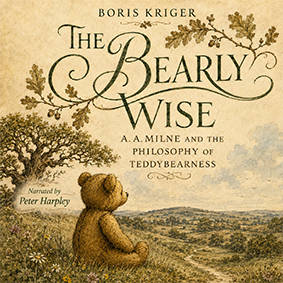
In August 1914, three weeks after Britain entered the First World War, a Canadian veterinarian on his way to the front bought an orphaned bear cub from a trapper at a railway stop in northern Ontario. He paid twenty dollars. He named her after the city he had just left. Four years later a boy met her at the London Zoo, borrowed her name for a stuffed toy he already owned, and gave the toy a surname he had taken from a swan.
Everything in that sentence is a substitution. The bear was named for a city she never saw. The toy was named for a bear it did not resemble. The illustrator drew a different bear altogether, one belonging to his own son. Nothing in the most famous animal in English literature is named after what it actually is—and the man who assembled it out of these borrowed parts had read mathematics at Cambridge, served as a signals officer at the Somme, and spent the last two years of the war writing persuasive fiction for British military intelligence.
This book argues that the Hundred Acre Wood is not a sentimental accident but a deliberate piece of philosophical engineering, and that its author knew precisely what he was doing. The Heffalump is an animal defined entirely by the hole dug to catch it. The North Pole is discovered by picking up a stick and announcing that the stick is the Pole. The Woozle is a set of footprints that turn out to belong to the creatures following them. A. A. Milne built a world out of things declared rather than found, and then showed, gently and without a single raised voice, what such a world can and cannot hold.
It can hold a great deal. This is a book about teddybearness—a stubborn, deliberate, faintly ridiculous decision to be gentle in a world that gives no reason for it—and about the two conditions Milne discovered that make such a decision survivable. The first is a resident pessimist whom nobody is allowed to cheer up. The second is a second creature, because nobody has ever managed to be teddybearly alone