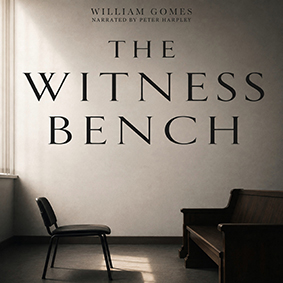
A family came to court to discover how their daughter died. Before the inquest is over, another person will be dead.
Sixteen-year-old Riya Kabir dies while detained in a mental health unit. Eighteen months later, her parents are still waiting for answers.
At the inquest into her death, barrister Sophia Vance begins to see troubling gaps between the official record and the evidence beneath it: questions about observation records, a use-of-force document recorded as not held, CCTV footage overwritten before it could be preserved, and a post-mortem examination conducted without information that would later prove significant.
No single document contains the whole story. No single answer explains what happened.
Then Charles Sterling, the senior executive responsible for quality and governance, takes the witness bench.
Riya's father, Anwar Kabir, has spent four days sitting only feet away, listening as his daughter's death is translated into the language of incidents, policies, recommendations and institutional learning. When Sterling gives his account of what the organisation has learned, something irreversible happens.
An inquiry into one death becomes a criminal case about another.
As Sophia moves from representing a bereaved family to defending a father accused of murder, the courtroom must confront not only what Anwar did, but the circumstances that brought him there, what the evidence can establish, and the distance between an official record and the human experience it is supposed to describe.
The Witness Bench is a restrained and psychologically acute literary courtroom novel about grief, evidence, language, institutional responsibility and the limits of what legal processes can resolve.
For listeners drawn to intelligent courtroom fiction and morally complex novels about justice, accountability and the difficult relationship between truth and proof.